Showing posts with label review. Show all posts

Saturday, 15 September 2012

Review: Dead on Demand


Dead on Demand by Sean Campbell
eBook

My rating: 2 of 5 stars


Synopsis
Dead on Demand is a crime novel describing the repercussions of one single person's desire to see someone dead.
Main character is Edwin Murphy, editor of a London based news paper. He's always put work before private life, and has been living on his own for some time when his wife finally files a divorce. Not only does she want half of his money, she also wants to move to New York with their little daughter.
Edwin cannot let this happen, so he devises a clever murder swap scheme to get rid of his wife, and later the woman who killed her for him, and more, until no connection remains...
Will the baffled police be able to see through his plans in time before he moves to Vancouver for a new job?

Impressions
Dead on Demand was a project of two brothers. They wanted to see whether they could write (+ advertise + publish) a crime novel together in 90 days. Obviously, they did. Was it worth it?
I've been pondering this question almost since I started reading the book (I got the Kindle version for free), and I still can't say for sure. The problem is that I don't really understand the goal, or maybe it's the definition of "novel" I'm missing here; of a publishable novel, that is.

The story the Campbell brothers created is intriguing, at least for most of the book. It kept me reading. Nevertheless, I could never recommend Dead on Demand to anyone, at least not without mentioning that it's been done in 90 days, because it shows. As I said, the story itself is fine, but the writing is of a quite low quality.
I've seen worse, it's true, but I can't imagine this novel making it to a book store ten years ago. Without eBooks and self-publishing, this would not have worked. Is that a bad thing, though? I don't know. All I can say is that, if you don't mind typos, relics from rephrasing and other mistakes that could easily be repaired by another round of editing, but you would like an interesting plot, read it (especially if it's still free).

Rating
For most of the book, I was pretty sure I would give it three stars in the end. At 94%, I had to change it to two. I'll give you three reasons for my rating, one for each missing star, if you want.

Mistakes (in general)
One advantage you get with eReaders is that you can easily mark mistakes and can count them later on. I've marked around 70 instances - real mistakes (like the wrong time used), needless word repetition, lack of comma and stuff that could have been worded better. 70 mistakes on 351 pages means one on every fifth page. A bit much? I think so.
If you want, I can give you some examples, but I don't want this to get too long now.

Julia
In the first chapter, Julia is described as an unwilling prostitute. She gets her customers in her own flat, has a pimp and does heroin. She also has a boyfriend, who is not allowed to know about that, and additionally works as a barmaid.
About halfway into the novel, she is killed. From my perception, this can only be a few months after that first description of her. Now, though, she has been living with her boyfriend for two years (they've known each other for four) in that same flat. There is no mention of her pimp, nor of drugs. What happened? I don't know.
At first, I thought there were two women named Julia, but the name of the boyfriend is the same. I don't know if it's just me who doesn't get it. I don't know if I've missed something. Maybe the guy whom Julia wanted to have killed was her pimp? But even then, she's been living with her guy for two years before that happened! How, when she's selling herself to men in there without him knowing?? If there is an explanation, it should be in the book, I think.

The Mistake at 94%
Since Julia was only a minor character and the story went on well afterwards, and since I've managed to live with the mistakes, I still intended to give the novel three stars. After all, it's been done in 90 days, so what could you expect? As I said, I changed my mind to the end of the book. There was this one, absolute terrible mistake.
Actually, I quite admired the Campbell brothers before that. They were playing with a huge number of characters, and keeping the overview must have been hell throughout (it's even difficult for the reader at times). They managed, though.
Right until they confused the name of their Chief Inspector with that of their main suspect. David and Edwin. Very alike, huh? That was the major turn off for me.

Conclusion
Dead on Demand is a crime novel written in 90 days. The lack of time put into it shows in the style. A lot. It also shows in the story at the end. They had to finish it, so they rushed to a final twist. The twist was a nice addition, the rush just sucked.

The characters show little development. Everybody seemed to be quite talented at killing, which I found weird. I never really understood Edwin's motivation, either. OK, getting rid of his wife, I get that, but afterwards...

I've said it before: read it if you don't mind the low quality, but don't expect it to be as good as a book from a professional publisher.


View all my reviews on goodreads.
Enhanced by Zemanta

Thursday, 6 September 2012

Review: Soul Music


Soul Music by Terry Pratchett
eBook

My rating: 4 of 5 stars


Soul Music, first published in 1994, is the next novel in the Death storyline. Death has, once again, problem with his profession and leaves to seek forgetfulness. He couldn't have chosen a worse time...
His talents are transferred to his granddaughter, Susan Sto Helit, who didn't know of her heritage since her parents, Ysabell and Mort, had a dispute with Death when she was small. Susan has difficulties with her new tasks, since she grew up to be a very sensible abd realistic person and just doing the Duty won't do for her.
At around the same time, a young harp player named Imp y Celyn tells his parents that he wants to be the greatest musician in the world. He leaves home and ends up in Ankh-Morpork, where he starts a band with a troll and a dwarf, whom he met at the (too expensive) musicians guild. When the troll accidentally ruins Imp's harp, they find him a guitar in a mysterious music shop. All of a sudden, music comes alive and brings fame and riches to the Band (With Rocks In). But don't the famous die young? It's all Susan can do to keep Imp, aka Buddy, alive and singing...
In the end, Death has to return to save the day, the discworld, and his most faithful servant.

I've read Soul Music in German before, but enjoyed the English version more. Translations can only get you so far (although I've also heard that 50 Shades of Grey is better in German)...
Anyway, Death is always an amusing character to read about, especially when he tries to be human, and it's almost sad that the main focus of this novel is on music, the Band and CMOT Dibbler making money (and failing horribly in the end). It lacks the usual philosphical component of Death novels.

Again, what I admired most about Soul Music was the continuity. I think it's amazing how Terry Pratchett doesn't make mistakes, even though he is working with only remotely connected storylines in his different discworld novels. There are always connections, guest appearances from characters of older books, and it always fits. J.K. Rowling didn't even manage that in seven books for just one story.


View all my reviews on goodreads.
Enhanced by Zemanta

Monday, 20 August 2012

Review: Men at Arms


Men at Arms by Terry Pratchett
eBook

My rating: 4 of 5 stars


Ah, I'm back at Terry Pratchett, and back in the British Books Challenge 2012.

Men at Arms (first published 1993) is discworld novel number 15, and the second focused on the Night Watch. It is set about a year after Guards! Guards!, where Captain Vimes and his crew were up against a huge dragon. This time, the enemy is not even of flesh and blood.

It all starts with the crazy mind of an aristocrat (and assassin), who wants a king for Ankh-Morpork, and who, by coincidence, recognises the current heir, who happens to be... well, present at all times anyway. In order to remove the Patrician and the current Guild structure, he steals the most deadly and dangerous weapon in existence: the gonne (I believe I don't have to explain to you what it is). It was invented by Leonard of Quirm and ordered to be destroyed by the Patrician, but instead it was kept in the assassin's museum. And it has a mind of it's own...
As more and more corpses - planned and accidents alike - turn up around the city, the Night Watch has to try and come to terms with the proceedings, as well as getting used to ethnic minorities as new recruits and the loss of Captain Vimes, who is going to be married and will be retiring in the process. Lucky for them that they have Corporal Carrot, then, who has a way of owning the city and bringing people to act as good as he believes them to be, so he can quell even the strongest of upheavals.


As someone who has enjoyed many a good murder mystery, I can definitely recommend Men at Arms to fellow readers. The plot is a thrill - as well as the usual Terry Pratchett funny - and ends on quite a surprise.
For me as a Terry Pratchett reader it was also great, because there were a lot of old acquaintances, mostly from Moving Pictures: Gaspode the talking dog, Ruby (Detritus' girlfriend), and even (if only with a small role) Mr. Silverfish of the alchemists. I guess you can read and enjoy the book even if you haven't read Moving Pictures before, but it's so much more fun to see how the old faces are never forgotten.


View all my reviews on Goodreads.
Enhanced by Zemanta

Wednesday, 15 August 2012

Review: Inheritance Cycle

Hardcover and Paperback

My rating: 3 of 5 stars


I started on the Inheritance trilogy (for back then it still was planned as such) shortly after the first volume, Eragon, was published, so it must have been around 2003. I enjoyed it, which is why the first three volumes are hardcovers in my personal library (normally, I wait for the paperbacks, because they're more comfortable to read, and cheaper). I guess the long wait for the fourth part made me forget about the whole series, since I was very surprised to receive it as paperback as a gift last Christmas. It was only this Summer's vacation that gave me the chance to read them all again.


Before I really bother you with my opinion of the series, let me give you a short long overview of the story (no, it is not entirely free of judgement or unnecessary comments).
It all starts with a boy called Eragon, who grew up at his aunt's and uncle's, because his mother left him shortly after his birth. Of course, this - and the mystery about his father's identity - is of great importance later. Eragon is off hunting in the mountains (which nobody but he dares enter) when a blue stone appears before him. It is accompanied by a huge explosion, which drives Eragon's prey away. He returns home with the stone, hoping to buy some meat with it instead, but nobody wants the thing.
It turns out pretty soon that it is not a stone at all, but a dragon egg - easy to recognise when a dragon suddenly hatches out of it. In Eragon's world - AlagaĆ«sia - only one dragon still exists: Shruikan, the king's dragon; suddenly discovering one outside the king's reach can only mean trouble. Still, Eragon touches the dragon hatchling and is bonded with her. He cannot bring himself to abandon or kill her, so he secretly brings her up in the woods behind his family's farm.
Of course, it cannot last. Two servants of the king - the Ra'zac -  appear in his village, asking questions, and he is forced to flee with the dragon, whom he named Saphira. His uncle is killed by the Ra'zac in the process, but luckily his cousin, Roran, is not home when it happens.
Eragon wants to kill the Ra'zac as revenge for his uncle's death, so he leaves with the old "storyteller" Brom, who helps him make a saddle for Saphira, and starts teaching him in fighting and magic while travelling. In the end, the Ra'zac kill Brom, who is replaced by Murtagh as Eragon's companion on the road.
Since he is unable to defeat the Ra'zac in his current state, he travels on to join the Varden, a group of rebels hiding from the evil king. Once there, it turns out Murtagh is the son of one of the king's followers (long dead), and later we also learn that he is Eragon's half-brother (his father was Brom, though).
What follows after all this are lots of fights, alliances with elves, dwarves and Urgals (huge, war-loving creatures), and more battles.

After the first book, the storyline is split to follow not only Eragon, but also Roran, who turns out to be a great warrior, and Nasuada, the leader of the Varden. Just to sum up a few key points:
Eragon and Roran manage to kill the Ra'zac, Nasuada manages to lead the Varden to battle against the Empire (and is all the while attractive enough to ensure Murtagh's assistance), and Roran saves his whole village and later many of the Varden besides.
In the end, Eragon - still a teenager - is the most powerful man in AlagaĆ«sia, which prompts him to leave the country with Saphira and a bunch of dragon eggs discovered between the battles. End of story.

Wednesday, 18 July 2012

Vacation Notice and Review: Always Remember to Tip Your Ninja


Lords and Ladies was the last book I read and reviewed for the British Books Challenge this month. I'm leaving for a two-and-a-bit weeks vacation early on Friday. There will be almost no internet access, and, anyway, I had planned to read my way through the four Eragon novels while away. Since they don't count towards the challenge and I - as already mentioned - won't have much internet, there will be no updates on goodreads or reviews here.

See you in August!


Always Remember to Tip Your Ninja: And Other Maxims for the Clinically Absurd
Jeremy C. Shipp
eBook

My rating: 3 of 5 stars


Always Remember to Tip Your Ninja is a collection of more or less funny slogans. It was entertaining enough for three quick lunch breaks, but I'm happy I got it for free. I have to say I never buy books without a story to them, though, so it might be just me.

Some of the "maxims" were really funny, others were quite dumb, and some I simply didn't understand.

Thursday, 12 July 2012

Review: Lords and Ladies


Lords and Ladies by Terry Pratchett
eBook

My rating: 4 of 5 stars


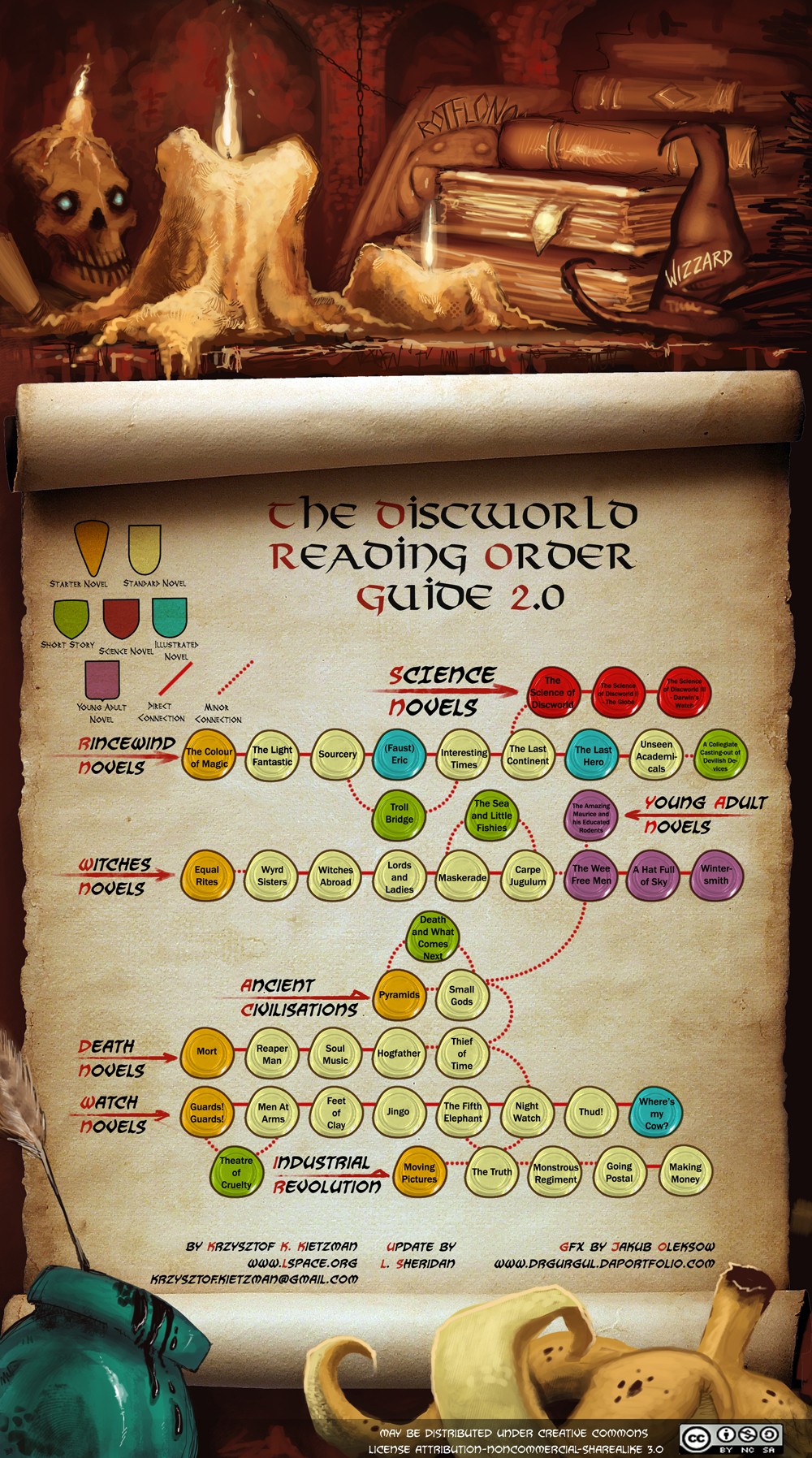
Lords and Ladies is the second discworld novel originally published in 1992. Overall, it's the 14th book, and the fourth from the witches storyline.

The first thing that surprised me here was that it does, in a way, stand on it's own, but there is a review of former books, especially Witches Abroad, the previous witches novel. Lords and Ladies picks up the story of Granny Weatherwax, Nanny Ogg and Magrat Garlick at their arrival in Lancre, when Magrat is informed that she will be married to King Verence II. soon. She doesn't really mind, but is of course very upset because she has apparently no choice in the matter; even the wedding dress has already been ordered without consulting her. Still, that is nothing to an argument she has with Granny Weatherwax, prompting her to give up witching and move into the castle even before the wedding.
It's only Granny and Nanny Ogg, then, who discover that someone had been dabbling with magic at the Dancers, an old stone circle protecting Lancre from Fairyland, which isn't at all as people think it is. They try to prevent the worst, but in the end, elves come through, taking over the kingdom. To really own the land, though, the Queen of the Elves has to marry the king, and Magrat won't have any of that... Neither would the other two witches, of course, but both are distracted by, well, men.

To me, Lords and Ladies was special because I've already read the much younger Tiffany Aching series, which starts with another invasion of the elves. It is very different from this one, but I remember that it was mentioned somewhere that Granny Weatherwax once got rid of the Queen, but wouldn't say how. Now I know.
Another thing that sets this novel apart from the other witches novels is the behaviour of Granny Weatherwax. She is uncertain, confused and a bit weak, absolutely not her usual self. And she has been planning ahead, manipulating people... To be honest, she reminded me a lot of Dumbledore (you know, Harry Potter). It was interesting to watch/read, and what made it even better were hints at her past.

Important guest roles this time were: Ridcully, current Archchancellor of Unseen University, together with the Bursar, the Librarian and Ponder Stibbons, Reader in Invisible Writings. Then there was Casanunda, the second greatest lover in the world and Nanny Ogg's flirt from Witches Abroad. On a side note, Mr. Ixolite the Banshee (from Reaper Man) is also mentioned.
Who is totally missing this time, though, is Death.


View all my reviews on goodreads.
Enhanced by Zemanta

Friday, 6 July 2012

Review: Small Gods


Small Gods by Terry Pratchett
eBook

My rating: 4 of 5 stars


Thirteen is my favourite number. Small Gods is the thirteenth discworld novel, but not my favourite, despite being very good. It was published in 1992.

Imagine being a small god, out in the desert... You need believers, to become strong, to get out of there. You find someone, a shepherd, and he spreads believe in you, starts a religion that makes you strong. Strong enough to fight other gods.
But, you don't care for people. They are only good for believing. Giving you power is their only purpose.
And then, one day, you come down to earth as a mighty bull, to trample some unbelievers... Only you're not a mighty bull but a small tortoise with no power at all. What would you do?

It takes the Great God Om three years in the desert before he gets to Omnia, his country. Since shape forms personality, he has almost forgotten who he is, but here is faith, believe to remind him of his identity. It also explains why he's a tortoise: the Great God Om has only one believer left, a novice with a strange mind and slow thoughts. He needs him; he has to stay alive, has to continue believing, maybe convince others...
The religion around the Great God Om is still going strong, but people believe more in the Church and the Quisition than they believe in their God. This is the way all gods go, eventually. Om puts up a fight, and, who knows, maybe having been a small tortoise for a while will change him...
And then, there is the last paragraph. Suddenly you hope that there are more people like Brutha, even here, somewhere.

Small Gods is a satire on religion. It is also a satire on politics, philosophy and warfare. It is a quite accurate description of people, as well.
Guest stars this time are Death, the Death of Rats and the Librarian. Is there any discworld novel at all which doesn't feature Death?


View all my reviews on goodreads
Enhanced by Zemanta

Tuesday, 26 June 2012

Review: Funeral Of Figaro


Funeral Of Figaro by Ellis Peters
Paperback

My rating: 4 of 5 stars


Funeral of Figaro, by Ellis Peters, was first published in 1962 as "operatic whodunnit", as it says. It tells of the events at Leander Theatre, near London, and the murder of one of the best Figaros in the world, right during the fourth act. The theatre company are a very tight-knit group, held together by Johnny, who started all this after the war. It's his war activities, smuggling goods and people, and not always strictly for his country, that bring him trouble with this Figaro, who doesn't belong to the original crew. That Johnny's teenage daughter seems to be interested in the man, who is as old as her father, doesn't simplify matters at all. But those are not the only motives for the murder, and Johnny certainly isn't the only suspect...
Detective Inspector Musgrave, who was in the audience as the crime happened, dives head-first into the investigations, using his time at the theatre to comment on the plays probably more than he comments on the case. No wonder everyone is happy to see him go once all is cleared, the man who prefers Wagner to Mozart!

Yes, I took another break from my Terry Pratchett quest. I found Funeral of Figaro at a jumble sale and, being a huge fan of Ellis Peters, was delighted to learn that she was British and I could include her in the British Books Challenge.
If you'd ever care to ask me for my favourite author, I'd have to name three: Terry Pratchett for his wit and the wisdom in his words, Oscar Wilde also for his wit and for almost making me cry in public, and Ellis Peters (or Edith Pargeter), whose talent with words and descriptions I deeply admire.
I read Funeral of Figaro during two five-hour train rides, almost unable to put it down to get some rest. If you've never read one of Ellis Peter's novels, but want to give her a try, this might be a good place to start.


View all my reviews on goodreads
Enhanced by Zemanta

Friday, 15 June 2012

Review: Reaper Man


Reaper Man by Terry Pratchett
Paperback

My rating: 4 of 5 stars


I bought Reaper Man at a jumble sale, last year or maybe the year before. This is the third time I read the book, and I couldn't put it down. In cases like this I think that not being able to put down a book isn't necessarily caused by wanting to know how it ends. For me, it's knowing how it ends and wanting to read - no, experience - it all again. Really good books can do this to you.

Reaper Man is Terry Pratchett's eleventh discworld novel, and was first published in 1991; it's also the second in the Death story line. In it, the so-called auditors of reality decide that the death of the discworld has to be replaced, seeing that he has developed a personality. So, when Death finds his own life-timer counting the seconds to his ceasing of existence, he leaves his realm to spend his remaining life time with the living (to great dismay of his servant, Albert). Under the name of one Mr. Bill Door, Death is hired as help on the farm of old Miss Flintworth, just in time for the harvest. Here, he experiences feelings, and sleep, and dreams, for the first time.
While he is away, though, things start going wrong all over the discworld. With no one to take the dying to the netherworlds, life force is building up, finding outlets wherever possible. One person extremely affected by this is the wizard Windle Poons (whom we've met in Moving Pictures as the oldest wizard at Unseen University), whose time has come to go. Upon dying, he ends up in a blackness, with nowhere to go except back to his dead body, which he does. Being a zombie isn't easy, though: you have full control over all bodily functions (by the way, how does the spleen work?) and when you've been looking forward to being reborn as a woman, spending the afterlife in your own dead body is no alternative. The other, alive, wizards at Unseen University are more than willing to help Windle die, but as none of their approaches work, he ends up at the Fresh Start Club, with other un-deads and people generally un-welcome in society.
Finally, while Death confronts the new death (wearing a crown!) to reclaim his job, Windle, the Fresh Starters and the wizards have to save the city of Ankh-Morpork from the consequences of superfluous life force.

Terry Pratchett is good at humour. It's what he is most famous for.
How often do people mention his talent for suspension and drama, though? Reaper Man is one of the discworld novels with this dramatic, touching, heart-breaking turning point that is so important for a good story.
The secret is, he won't leave you with that. A discworld novel always ends with something funny, relaxed, witty. For the balance of things.


View all my reviews on goodreads
Enhanced by Zemanta

Monday, 11 June 2012

Review: Moving Pictures


Moving Pictures by Terry Pratchett
eBook

My rating: 5 of 5 stars


Moving Pictures is the first in the so-called "Industrial Revolution" line of discworld novels. It was published in 1990, the same year as Eric, and is a wonderful satire on Hollywood and the film industry.
Main characters in this story are Victor Tugelbend, who devised a very intelligent system to fail exams at Unseen University "good enough" not to be thrown out, and Theda 'Ginger' Withel, who just wants to be herself, as big as possible. They are both drawn away from their day-to-day lives by a wild (and dangerous) idea - the same idea which helped the alchemists invent the 'clicks' (as in movies) and which made Cut-Me-Own-Throat Dibbler a very successful producer (because he knows how to advertise). They all meet at Holy Wood, a hill between dunes and close to the ocean, which hides from them a civilisation long gone...
Victor and Ginger notice that something is wrong about Holy Wood (and it's not because of the talking animals that hang around there). Well, them and the wizards in Ankh-Morpork, who have a device that shows where reality is unravelling, and how much. Only they don't know what it does, and like Victor and Ginger they only figure it out at the last moment - just in time to save the discworld from the Things from the Dungeon Dimensions?

Having finished with the tenth discworld novel now, I must say that what I love and admire most about the whole series is the recurrence of characters. I've met CMOT Dibbler, and of course Detrius, before, and the next novel puts old Windle Poons right in the middle of its plot, after he's been introduced in Moving Pictures. Discworld characters are - in general - a weird and funny bunch, and it's great fun meeting them all again from time to time, as minor characters to another story.

For a conclusion on Moving Pictures I want to mention that I definitely didn't get all the movie references, and probably misunderstood a lot of them (after all, the book is 22 years old). Nevertheless, the novel made me laugh a lot, and the grand final was again grand.
I'll leave you with one of my favourite quotes from the book: "Just when you need to save the world, there's a world for you to save".


View all my reviews on goodreads
Enhanced by Zemanta

Tuesday, 15 May 2012

Review: Guards! Guards!


Guards! Guards! by Terry Pratchett
eBook

My rating: 4 of 5 stars


Guards! Guards!, first published 1989, introduced another new set of characters to my personal discworld universe: Captain Vimes and the rank of the city watch.
The book covers and unites multiple story-lines: the one of Carrot, a human raised by dwarfs, who is sent to the city to be with his own kind, and who applies at the city watch to do good. At the same time, a secret society aims at overthrowing Ankh-Morpork's ruler, the Patrician Lord Vetinari, in order to install a manipulable king. They do so by summoning a dragon, using a book stolen from the library of Unseen University and diverse stolen magical items. As anyone who read, for example, the wizard novels can deduce from that: the Librarian is not happy.
The main focus of Guards! Guards! is on Captain Vimes, though, who stops his alcohol abuse in order to be able to get rid of the dragon and protect his city. It's a somewhat clichƩd police story, that, but nicely done and quite in discworld style. Together with the rest of the - mostly incompetent - city watch, the Librarian and Lady Sybil Ramkin, breeder of pet swamp dragons, it's Captain Vimes who tries to stop the dragon after the secret society lost control over it and it became king of Ankh-Morpork (amazing what concepts people can wrap their minds around).

Quite a bit of the story is based on the way people believe in stories and sayings - how to recognise a king, one-in-a-million chances, the behaviour of dragons... That makes up most of the novels charm: a mirror to the stupidity of people. Plus, there's dragons and I learned about L-space.
Satire, humour, dragons and L-space - definitely a book worth reading.


View all my reviews on goodreads.
Enhanced by Zemanta

Monday, 7 May 2012

Review: The Virgin Student


The Virgin Student by Virgin Student
eBook

My rating: 3 of 5 stars


I took another short break from my goal to read all discworld novels. A Goodreads review on The Virgin Student had caught my eye by coincidence, so I took a day off from Terry Pratchett to read it.

The Virgin Student originally was a blog, turned quite nicely into an eBook. The blog was started in summer 2005 by an Oxford student who had just done her finals. Being 21 and still a virgin, she decided to go on a quest to lose her virginity before leaving college in three weeks time. The blog quickly became popular, partly because of the way the author described the dates she went on to find the right guy, partly because, well, she advertised her virginity on the internet!

The Virgin Student was a very interesting read, especially thanks to the comments of the blog's readers, which were included. It's not only the tale of a girl trying to lose her virginity. It is also about what sex actually is, with many a heated discussion about lesbians, virginity, oral sex and the big O.
Personally, I was surprised how naive a girl of 21 could be in times of the internet, but that's just the charm of the book. Had she known more about sex, it would have been a lot less interesting to follow her journey of self-discovery.


View all my reviews on Goodreads.
Enhanced by Zemanta

Sunday, 6 May 2012

Review: Pyramids


Pyramids by Terry Pratchett
eBook

My rating: 5 of 5 stars


It is a terrible thing, having your believes destroyed by truth. Sometimes, it is even more terrible to see that you were right.

Pyramids, first published 1989, follows young Teppic, only son of king (Pharaoh) Teppicymon XXVII. He has decided to get his education outside of the small desert kingdom Djelibeybi, so he travels all the way to Ankh-Morpork to join the Assassins Guild. The book starts with his final examination, telling his story in flashbacks as he succeeds.
Shortly afterwards his father dies and the kingdom calls him back home. Suddenly, he has to get used to the old ways of the kingdom again, and he discovers that being king isn't at all as he expected. For example, he doesn't seem to have anything to say.
When the erection of the greatest pyramid ever build (for his father, even though he doesn't want one) tears the whole valley along the Djel out of reality, Teppic, who is not present then, has to make up his mind whether or not he is going to try to go back and save it. Meanwhile, in the kingdom's new reality, all that was ever believed there becomes true, and citizens and priests alike come to realise that it is much more comfortable believing in gods you cannot see (especially the ones with too many heads or legs).

Before I started with Pyramids I didn't know there was an Ancient Civilisation line in the discworld novels. I enjoyed the book immensely, the greatest mathematician of the world was good fun, and the criticism of religion and the unwillingness to let go of the old ways rings very true. Plus, the slow motion climax of the story would have been worth the special effects Oscar, if only it had been in a movie.
Even if you are not interested in diving into the whole discworld universe, you still should give this specific volume a try.


View all my reviews on goodreads.
Enhanced by Zemanta

Friday, 20 April 2012

Review: Wyrd Sisters


Wyrd Sisters by Terry Pratchett
eBook

My rating: 4 of 5 stars


Wyrd Sisters is the second discworld book about witches, published (1988) only a year after Equal Rites, which first introduces Granny Weatherwax. Personally, I liked Wyrd Sisters a lot better than Equal Rites, and that's not only because it contains daggers, ghosts, kings and more, although all play a major role in the story.

Yes, the story. It goes as follows: King Verence of Lancre is killed by Duke Felmet, his cousin, via persuasion of his wife. A faithful servant manages to rescue crown and child of the king and bring both to the three witches that live in this country: Granny Weatherwax, Nanny Ogg and Magrat. They decide to become his godmothers (including good wishes for the child) and then give it away to travelling actors, in whose props-box they also hide the crown.
Duke Felmet, going crazy with the terrible deed he has done, not-so-secretly hates the country he now rules (as duke, for there is no crown to make him king), and the country hates him. It asks Granny for help, but witches don't meddle. The witch in question only changes her mind when Nanny Ogg is brought in for torture and the people lose their respect for witches. With a clever trick from a well-known fairy tale, she speeds up the whole story. But beware, not all things go as planned when the heir finally returns...

Wyrd Sisters is a whole book of fun, stories and headology, with an extra spicing of love and destiny. It is also a great reference in case you always wanted to learn more about how storms learn, think and listen.


View all my reviews on goodreads.
Enhanced by Zemanta

Monday, 9 April 2012

Review: Sourcery


Sourcery by Terry Pratchett
eBook

My rating: 4 of 5 stars


I must admit that I'm growing quite fond of Rincewind, the inept wizard. It's a pity he tends to disappear, or probably die, at the ends of his novels. I never know whether or not he will be back.


Anyway, Sourcery (first published 1988) is about the eighth son of an eighth son (wizard) of an eighth son: a sourcerer. They are very, very powerful, sourcerers (= sources of magic), and also very rare. There is a reason why wizards don't have much, or any, contact with women... And it can get worse when the sourcerer's father wants revenge for being banished from Unseen University for having fallen in love.
Rincewind, together with Conina (the daughter of Cohen the barbarian) and the Luggage sets out to save the Archchancellor's hat, symbol of wizardry, from the sourcerer, only to find that the hat has plans of its own, which could lead to the Apocralypse, the end of the world. In order to stop the oncoming mage war, Rincewind has to kill the sourcerer, a ten-year-old boy who is forced to help wizards rule the discworld.

As always, Rincewind goes about the business of being an involuntary hero using his rodent-like talent to escape death and arguing with his consciousness about what should be done in contrast to what would be sensible to do. To make matters worse, he (and the Luggage) both fall in love (symptoms: sweaty palms, hot sensation in stomach, skin of chest made of tight elastic, someone running hot steel into spine), which leads to the Luggage getting seriously drunk and lost.
In addition to Rincewind and the Luggage, the novel is populated with weird and funny characters. There's Conina, forced to be a heroine by genetics but wannabe hairdresser, Nijel the Destroyer, a wannabe hero, and Creosote, a rich wannabe poet. They all have their own to contribute to save the discworld from destruction when the Gods vanish and the Ice Giants return.

Sourcery was a lot of fun to read, finally making Rincewind one of my favourite Terry Pratchett characters. You shouldn't read it without having read the other Rincewind novels first, though.
Compared to the last discworld book I read, there was a lot less repetition this time, which made me all the more happy. I'm already looking forward to the next book (and regretting slightly that I'm going by publishing order, since I want to know how Rincewind gets back)!


View all my reviews on goodreads.
Enhanced by Zemanta

Friday, 16 March 2012

Review: Pike's Quest

Pike's QuestPike's Quest by K.J. Bennett
eBook

My rating: 3 of 5 stars


Pike's Quest, self-published by indie author K.J. Bennett in October 2011, is a fantasy novel set in the far future, after mankind has – almost – destroyed the earth. Here, in the age of the New Dawn, a fish-faced boy named Pike is destined to be a hero and save the world from... Well, never mind, I want you to go and read the book, so don't expect details!
I was warned before I started reading that there would be a lot of that so-called English or British humour which I always thought I enjoy. And I did! Only that I realised I probably don't get is as much as I thought. That being said, here is my opinion of the book.

I really enjoyed the beginning, the description of Pike as a kid, the irony with which he is mobbed. It made me laugh a lot, and then I got tired of it.
I really enjoyed the ending; it had the grand final battle which you expect in a fantasy adventure. It kept me glued to the screen of my eReader.
It's just the middle part which makes writing this review a bit difficult: I don't understand it. More precisely, I don't understand the characters. The story line is very clear and well laid-out, the pace with which everything happens is, probably, a bit rushed, but you don't have to stretch, right? The characters, though...
There's Pike, who is told by a warlock that he is destined to be a hero, and although Pike neither wants to be one or thinks he could be one, he goes on a quest guided by a talking sparrow. Why? Because he is told that it is his destiny. Maybe that's meant to be satirical, in fact I hope so. Otherwise, it would just be a lack of character development.
Pike is not the only character I don't understand. Some scenes, some actions throughout the book, really threw me off, because some character did something that didn't fit the personality I thought that character had. To me, it looked like it was done simply because the storyline required it.
I think the characters that populate the world in the New Dawn are interesting, funny, weird – all you need for humorous fantasy. I'm just not sure, because I don't think I really got to know them, and that's a pity.

Overall, I enjoyed Pike's Quest. It was funny. It was clever. Maybe it was too clever for me. I think you should judge for yourself. It's not expensive, and it is worth it.

View all my reviews on goodreads.

Sunday, 12 February 2012

Review: Equal Rites


Equal Rites
Equal Rites by Terry Pratchett
eBook

My rating: 3 of 5 stars


Despite this wonderful picture, I decided to read through the whole discworld series in publishing order. This means that today my third review for the British Books Challenge 2012 is about Equal Rites, first published in 1987. Please be aware that this review contains spoilers.

The first two novels introduced and followed the wizard Rincewind, while this third book turns towards the witches of the discworld, who practice magic on a very different level. In Equal Rites, by the mistake of an old wizard in a hurry, a new born girl inherits the magical staff of said wizard. The baby was thought to be the eighth son of an eighth son, destined to become a wizard, and the old wizard in question wanted to give his staff to the boy before his own death. As is so often the case with men – and especially with wizards – he didn't pay any attention to the witch – Granny Weatherwax – who had helped during the birth of the child. She tries to tell him that it's a girl, but neither he nor the baby's father listen until it's too late. The father, who is the local blacksmith, tries to destroy the staff afterwards, but is unable to do so. He hides it instead and hopes that his daughter will grow up normal. Which of course she doesn't.
Around the age of eight, she is lost in the woods at night, in winter. When wolves threaten to harm her, the staff comes to her rescue, killing the wolves. After this incident, Granny Weatherwax tries – in vain – to destroy the staff. She also takes on the girl, whose name is Esk, as apprentice to become a witch. She tries to train her, but it become apparent that Esk cannot control her wizard powers when she turns one of her brothers into a pig. Granny Weatherwax then takes Esk to Unseen University for training, but women are not meant to be wizards... That she helps save the world does give her a certain advantage, though.

I know Granny Weatherwax from the much younger series around Tiffany Aching. She's called Mistress Weatherwax there and – somehow – totally different from the witch in this book! Not in all aspects, mind you, but still very different. This is the main reason why I didn't like Equal Rites as much as I could have. It was so confusing to read! Still, there was fun and adventure, as you would expect from Terry Pratchett, so it's still worth recommending.


View all my reviews on goodreads.
Enhanced by Zemanta

Saturday, 28 January 2012

Review: The Light Fantastic


The Light Fantastic
The Light Fantastic by Terry Pratchett
eBook

My rating: 4 of 5 stars


The Light Fantastic by Terry Pratchett is the sequel to his first discworld novel, The Colour of Magic. Published three years after the first, in 1986, the book starts off where we were left, with Rincewind the inept wizard falling from the disc. The Octavo, a very potent grimoire, goes to great length to save his life - or, to be more exact - to save one of the Eight Spells of the creator, which had taken up lodging in Rincewind's head some years previously. One moment falling right into space, next moment he finds himself in a wood of talking trees. He is reunited with the tourist Twoflower, but we never get to know what happened to Tethis the water troll, who was inside the Potent Voyager, a space capsule, with him.
Rincewind and Twoflower continue their travels across the disc, being pursued by wizards and accompanied by yet another hero, Cohen the Barbarian. This time, they meet druids building a kind of magical computer, they take a short stroll through Death's realm, are kidnapped, then saved by trolls, and so on. All the time, a new, red, menacing star grows bigger in the sky, threatening to destroy the discworld. Or is it? In any case, it is driving people mad with fear and curiosity.

I liked this second discworld novel quite a bit more than the first. It has more of a storyline; it was clear quite early that the goal would be to return to Ankh-Morpork and everything that happens somehow works towards this goal. Then comes the showdown, epic fights and heroic deeds (done by Rincewind, who was the greatest coward ever known before). The sudden change of character fits, though, as he is finally home and tired of running away again.
Disappointing, for me, was that we still don't know what happened to Hrun the Barbarian and Tethis from The Colour of Magic. Books that give no satisfactory explanation of the disposition of some of their characters, however minor they may be, always upset me.

Overall, it was a good read. The Light Fantastic is funny and exciting, but now that I'm getting used to reading Terry Pratchett again, and the first excitement for reading the whole series has faded, I can't help noticing that his later novels are, well, better. I'm looking forward to continue with the discworld novels and follow the author's development.


View all my reviews on goodreads.
Enhanced by Zemanta

Sunday, 22 January 2012

Hugo - a Review

The Sony Reader PRS-T1, or, as I call it - for no other reason than it was the first name I could think of - Hugo is exactly what I was looking for. Admittedly, I didn't get a chance to compare it/him with any other tool yet, but I don't have to to love it (him?).

First of all, I guess you'll need to know what I was looking for in an eReader, to understand what I like and dislike about Hugo.
Since I got some paperbacks in a terribly huge format for Christmas, I thought of buying an eReader to continue being able to read on the road. The thought, though, of having some electronic device with me at all times, gave me the idea that I'd love to write on it as well. I have a blog with flash fiction and not much time to maintain it, so the hour I spend on public transport would be ideal for writing, as long as what I write could easily be synchronised with my laptop or the PC in my office. I settled for the Sony Reader after some research, also into the tablet department, since eInk displays are more comfortable to the eye and the battery lasts much longer.

Negative points first:
I live in Germany. That often turns out to be a problem these days (blocked YouTube content and such), and it is a minor disadvantage here as well. Hugo, you see, comes with two pre-installed book stores: the Sony Reader Store and Google Books (yay!). Both do not work in Germany yet. Great. I tried downloading a free eBook from Google Books via the integrated browser, but Hugo was not able to open it. This leaves me only with the computer software to synchronise via USB. That, fortunately, is easy and fast.
Still, the software is my absolute hate point with the Sony Reader. It always synchronises both ways (at least, I haven't found a way to change that) and if some files (like notes for my blog) are the same, the files from the computer overwrite those from Hugo, no matter the edition date. This led to me losing quite a large fraction of a story already. Thank you, Sony.
As another minor point, I'd like to mention that a stylus is included, but without some place to put it, neither on the Reader itself, nor on the optional cover. Is that really too much to ask?

Why I love Hugo:
Hugo is sexy. Slim and light, and very easy to use. Apparently it has some problems with PDFs, sometimes, but ePUBs work well.
Typing is very, very fast. In fact, it is faster than the eInk display, but still no letters get lost. I love this.
Hugo comes, of course, with a pre-installed browser and also some dictionaries (more languages than I would ever need), in case you wanted to know.
The main reason that made me fall in love with Hugo, though, is that is works with Android. I don't have any experience with this, but still - thanks to the internet - I was able to root the Reader in less than five minutes. Now I have Dropbox installed, which allows writing in .txt format online, on my laptop, and on Hugo (offline). It synchronises very fast via WLAN, too. Never will use the stupid software again (for notes)!

Overall, the Sony Reader PRS-T1 is certainly a good eReader, with all functions that I saw people look for. And for people like me, who want a bit more, it is (probably) perfect.

This review has been written for Goodreads.
Enhanced by Zemanta

Monday, 16 January 2012

Review: The Colour of Magic

The Colour of Magic
Image via Wikipedia
The Colour of Magic by Terry Pratchett
eBook

My rating: 4 of 5 stars


In his first discworld novel, first published in 1983 (two years older than me!), Terry Pratchett takes the reader on a tour around his magical world by sending the first ever tourist of the discworld, Twoflower, to explore it. He is accompanied - most unwillingly - by the inept wizard Rincewind, and his (the tourist’s) Luggage, a huge wooden chest made of sapient pearwood, which follows him wherever he goes and keeps his belongings save by eating those who want to steal it. On their travelling from Ankh-Morpork to the Hublands to the Rimfall, Twoflower and Rincewind meet many people and monsters, from thieving heroes to imaginary dragons. The ending is left open and will be continued in the next novel, The Light Fantastic, or so I have heard.

I had some minor problems with the book, mainly because I have already seen the movie twice and, as is so often the case, comparison is a bad idea but hard not to do. Even with the difference which irritated me, though, I enjoyed the book and had to smile at several occasions. The optimistic, naive and - most of all - curious Twoflower and his counterpart, the pessimistic, seemingly ill-starred Rincewind, are a great team when it comes to surviving all that Fate (the God) happens to throw their way, and they entertain the reader at the same time. Admittedly, they receive some help from the Lady in that great board game the Gods play...
The only thing that really irks me is the matter of Hrun the Barbarian, who joins Rincewind and Twoflower at the Temple of Bel-Shamharoth and simply vanishes after their clash with the people of the Wyrmberg. I hope he will return with some kind of explanation in the next book.

For readers who want to get to know Terry Pratchett and/or the discworld, I can definitely recommend The Colour of Magic. The skilled writer that he is, Pratchett manages to describe the discworld to the outsider without losing sight of the story, introducing important terms and facts (e.g. Great A'Tuin, the world turtle, the names of the four elephants that carry the disc, the Big Bang hypothesis and the eighth colour, octarine) and comparing it to our world (magic versus technical progress, views and opinions, etc.). I believe that you can read and understand the other discworld novels without having read this one first, but if you like the discworld, you need to read this book.


View all my reviews on goodreads

Enhanced by Zemanta